


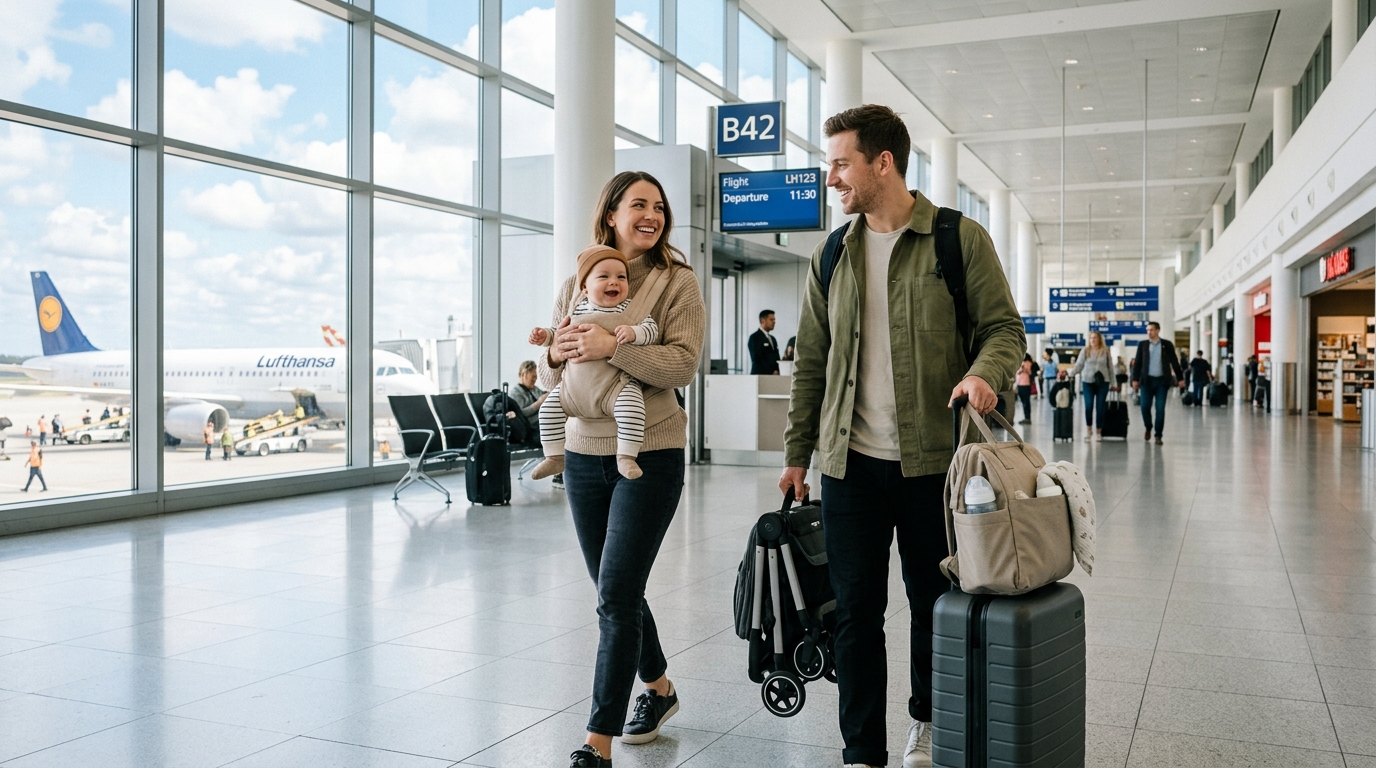
The boarding line barely moves.
A parent shifts a heavy diaper bag while holding a crying baby, with a folded stroller and car seat already adding to the load.
In that moment, many families realize something unexpected: flying with an infant is often easier than managing all the gear that comes with one.
Most stress isn’t the flight itself; it’s deciding what to bring, what to leave, and what can wait until arrival. That balance makes all the difference in crowded airports and long travel days.
Many of the best flying with a baby tips have very little to do with the airplane. They start before departure, with smarter decisions about gear.
-
Pack for the flight experience, not the entire trip.
-
Large baby equipment is often easier to rent at the destination.
-
TSA rules allow formula, breast milk, and baby food beyond standard liquid limits.
-
Not every piece of baby gear needs to travel with you.
What Age Can You Fly with a Baby?
One of the most common questions parents ask is simple: when can babies fly on airplane trips safely?
There isn't one universal age requirement.
For healthy full-term babies, air travel is generally considered safe after the newborn period, although many pediatricians recommend discussing travel plans if the baby is very young or has medical concerns. The exact timing often depends on the infant's health, destination, and flight length.
What surprises many first-time parents is that age isn't usually the biggest challenge.
Routine is.
A two-month-old may sleep through much of the flight. A ten-month-old who recently learned to crawl? Different story.
A helpful way to think about airplane travel with infant planning is this:
-
Consider your baby's feeding schedule.
-
Think about sleep timing.
-
Expect routines to shift.
-
Build flexibility into the day.
Trying to maintain a perfect home schedule while traveling often creates more stress than simply adapting.
Security checkpoints create anxiety for many parents because nobody wants surprises while carrying bottles, formula, snacks, and feeding supplies.
Fortunately, TSA baby gear rules are more flexible than standard liquid restrictions.
Formula, breast milk, toddler drinks, and baby food are allowed in carry-on bags in quantities larger than 3.4 ounces. They do not need to fit inside the standard quart-sized liquids bag. Parents should inform TSA officers before screening begins.
A useful travel habit: separate feeding supplies before reaching security.
It sounds small, but it can speed things up considerably.
Parents carrying breast milk should also know that ice packs, freezer packs, and cooling accessories are permitted, even when transporting expressed milk.
One practical reality often missing from travel guides: screening procedures can vary slightly between airports. Community discussions from frequent travelers show that some checkpoints conduct additional testing while others move passengers through quickly. Giving yourself extra time helps avoid unnecessary stress.
Quick Security Checklist
-
Formula or breast milk separated from other liquids
-
Extra bottles packed for delays
-
Diapers easily accessible
-
Wipes stored near the top of the bag
-
Change of clothes for the baby
-
Spare shirt for the adult carrying the baby
That last item tends to become important at exactly the wrong moment.
What to Bring on the Plane with a Baby
The biggest packing mistake?
Preparing for every possible situation.
Parents often bring far more than they actually use.
When deciding what to bring on plane with baby, focus on comfort, feeding, and containment.
Those three categories solve most problems.
Bring These
-
Diapers for the flight plus delays
-
Wipes
-
Formula or feeding supplies
-
Pacifiers, if the baby uses them
-
Two changes of baby clothes
-
One adult shirt
-
Small blanket
-
Favorite comfort item
-
Lightweight toys
The goal isn't entertainment overload.
It's rotation.
A single toy can feel brand new again after disappearing into a diaper bag for thirty minutes.
Skip These
Some baby products seem essential at home but become unnecessary during flights.
Consider leaving behind:
-
Large toy collections
-
Bulky activity centers
-
Oversized feeding equipment
-
Extra baby containers are used only occasionally
Parents sometimes pack for worst-case scenarios instead of likely scenarios.
The result? More weight. More baggage. More frustration.
A Smarter Baby Gear Strategy
Not all baby gear serves the same purpose during travel.
Some items help during transit.
Others only matter once you've arrived.
Separating those categories changes everything.
|
Bring With You |
Usually Better to Rent |
Often Safe to Skip |
|
Diaper bag |
Full-size crib |
Large toy bins |
|
Feeding supplies |
High chair |
Activity centers |
|
Favorite comfort item |
Full-size stroller |
Excess clothing |
|
Lightweight carrier |
Pack 'n Play |
Duplicate gear |
|
Travel documents |
Booster seat |
Rarely used accessories |
This approach often reduces luggage volume significantly while still giving families access to equipment they actually need.
Gate Checking vs. Renting a Stroller at Your Destination
The debate around gate check stroller vs rent stroller decisions usually comes down to convenience versus simplicity.
Gate checking works well for many families.
You use your stroller through the airport, hand it off before boarding, then collect it after landing.
Simple enough.
Until damage happens.
While most gate-checked strollers arrive safely, travel can be rough on wheels, frames, and folding mechanisms.
Renting changes that equation.
Instead of navigating airports with a stroller, families arrive and use one already waiting at the destination.
For longer vacations, theme park trips, family visits, or city stays, renting can reduce both airport stress and packing demands.
A familiar scenario illustrates why.
A family flies across the country with a baby and a toddler. Between luggage, snacks, car seats, and carry-ons, every additional item becomes another thing to track. Renting larger equipment at the destination means fewer moving parts during the travel day.
That's often where stress starts to decline.
Car Seat on a Plane: Required or Optional?
The question of using a car seat on airplane flights creates plenty of confusion.
Technically, many airlines allow infants under two to travel as lap children.
That doesn't necessarily mean it's the most comfortable option.
For some families, bringing a car seat provides:
-
Familiar sleeping conditions
-
Better containment during long flights
-
Consistent seating position
-
Reduced fatigue for caregivers
Others prefer traveling lighter and checking the seat instead.
Neither choice is universally right.
A few factors usually determine the better option:
Consider Using the Car Seat If:
-
The flight exceeds several hours
-
The baby already naps well in the seat
-
You're traveling alone
-
You purchased a separate seat
Consider Checking It If:
-
The flight is short
-
The baby rarely tolerates the seat
-
You're minimizing gear
-
Alternative transportation is already arranged
A common mistake is assuming every piece of baby safety equipment has to travel on every trip.
Travel conditions change, and the packing strategy should too. Adjusting what you bring based on the trip can make travel simpler and less stressful.
How to Rent Baby Gear at Your Destination
The concept to rent baby gear at destination has become increasingly common because it solves a very specific problem.
Parents need equipment.
They don't necessarily need to transport equipment.
The process is usually straightforward:
-
Select travel dates.
-
Choose the equipment needed at the destination.
-
Schedule delivery.
-
Use the gear during the stay.
-
Arrange pickup or return.
For families visiting relatives, staying in vacation rentals, or spending time in hotels, this can eliminate several oversized items from the packing list.
A service like Travelling Baby is built around that idea. Instead of hauling full-size cribs, strollers, high chairs, and other bulky equipment through airports, families can arrange for gear to be available after arrival when those items are actually needed.
The biggest benefit isn't necessarily convenience. It's mobility.
Parents often underestimate how much easier airports feel when they're carrying only what the baby needs during the journey itself.
What Most Parents Misjudge
The real challenges are the transitions: airport parking, security, baggage claim, hotel check-in, and late-night arrivals with a tired baby. In those moments, excess gear can quickly become a burden.
One widely cited figure from the U.S. Department of Transportation shows that U.S. airlines carried over 853 million passengers in 2023, reflecting how many families move through airports each year. With that volume comes a simple lesson for every traveling baby and family: efficiency matters, not minimalism for its own sake, but bringing only what truly serves the trip.
The Do's and Don'ts That Matter
Do
-
Pack for the travel day separately from the vacation.
-
Bring feeding supplies in easily accessible bags.
-
Expect schedule disruptions.
-
Research destination equipment needs before leaving.
Don't
-
Assume every baby item must fly with you.
-
Overpack toys.
-
Wait until security to organize liquids.
-
Treat every trip exactly the same.
Different destinations create different needs.
A weekend family visit looks nothing like a two-week beach vacation.
Final Thoughts
Most successful flying with a baby tips come down to one mindset shift.
Travel with what you need during the journey.
Access what you need after arrival.
Once parents stop trying to transport an entire nursery through the airport, travel often feels surprisingly manageable.
Not effortless. Babies remain unpredictable.
And when you're walking through a crowded terminal with fewer bags, fewer oversized items, and one less thing to worry about, that difference becomes noticeable fast.
FAQ
What makes a good baby gear for flying setup?
A good setup focuses on essentials only. Feeding supplies, diapers, comfort items, and lightweight travel gear usually matter more than bringing every product used at home.
What are the best practices for airplane travel with infant routines?
Keep feeding and sleep expectations flexible. Plan for delays, bring extra supplies, and prioritize comfort over maintaining a perfect schedule.
How to rent baby gear at destination locations?
Most rental services allow parents to choose equipment online, schedule delivery, and arrange pickup after the trip ends.
When should families use professional baby gear rental services?
Professional rental services can make sense when traveling with bulky items like cribs, high chairs, or full-size strollers that are difficult to transport through airports.
What services does Travelling Baby provide for traveling families?
Travelling Baby provides baby equipment rentals such as cribs, strollers, car seats, high chairs, and other travel essentials delivered to destinations across many U.S. locations.

